

WVU Medicine Uniontown expands robotic-assisted surgery
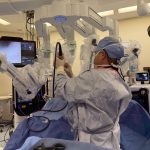
WVU Medicine Uniontown Hospital has expanded its commitment to advanced surgical care with the addition of two da Vinci 5 robotic surgical systems, giving patients in Fayette County access to the newest generation of robotic-assisted surgical technology.
Uniontown Hospital is currently home to two of the four da Vinci 5 systems operating in western Pennsylvania, reinforcing the hospital’s continued investment in bringing leading-edge surgical care closer to home for patients throughout Fayette County and the surrounding region.
Uniontown Hospital’s two new da Vinci 5 systems are part of a significant WVU Medicine investment in expanding access to robotic-assisted surgery throughout the region. With the recent acquisition of 17 additional da Vinci 5 systems, WVU Medicine now has 41 robotic surgical systems across 16 hospitals in West Virginia, Maryland, Ohio, and Pennsylvania, representing the largest fleet of surgical robots in the region.
As Intuitive’s newest robotic surgical platform, the da Vinci 5 includes more than 150 design innovations, including enhanced visualization, force-sensing technology, and telepresence capabilities. The systemwide investment allows community hospitals like Uniontown to offer patients access to the latest surgical technology while connecting local surgeons with the expertise and resources of the broader WVU Medicine system.
The hospital’s first procedure using the new platform was performed by Brandon Ball, M.D., F.A.C.S., chief of Surgery at WVU Medicine Uniontown Hospital, who successfully completed a robotic-assisted gallbladder removal on a patient from Morgantown, W.Va. on Aug. 3.
“The addition of the da Vinci 5 represents another significant step forward in the care we provide our patients,” Ball said. “This technology enhances the precision and visualization available to surgeons while allowing us to continue performing complex procedures through a minimally invasive approach. Ultimately, that means many patients experience less pain, smaller incisions, shorter hospital stays and a quicker return to their normal activities.”
During robotic-assisted surgery, the surgeon remains in complete control of the operation at all times. Through several small incisions, specialized robotic instruments and a high-definition three-dimensional camera are positioned inside the patient’s body. From a nearby surgical console, the surgeon precisely controls every movement of the robotic instruments, allowing exceptional dexterity, visualization, and precision throughout the procedure.
Unlike traditional open surgery, robotic-assisted procedures are performed through small incisions, often reducing blood loss, postoperative pain, scarring, and recovery time while helping patients return home sooner.
“The robot never makes decisions or performs surgery independently,” Daniel Battista, associate vice president of hospital clinical operations, said. “It is an advanced surgical tool that translates the surgeon’s hand movements into incredibly precise movements inside the body. It allows us to perform surgery with greater precision while maintaining complete control throughout every procedure.”
The da Vinci 5 platform builds upon previous generations of robotic technology with enhanced imaging, improved instrument control, advanced computing capabilities, and features designed to further support surgeon performance and patient care.
“This investment reflects our continued commitment to bringing advanced healthcare to the communities we serve,” Karyn Wallace, president and CEO of WVU Medicine Uniontown Hospital, said. “Patients shouldn’t have to travel long distances to access the latest surgical technology. By investing in our physicians, our surgical teams and state-of-the-art technology, we’re ensuring our community has access to world-class care close to home.”
The addition of the da Vinci 5 systems continues the rapid growth of robotic surgery at Uniontown Hospital. Since launching its robotic surgery program in July 2025, the hospital’s surgeons have performed more than 400 robotic-assisted procedures across multiple specialties, including general surgery and gynecology.
For more information about robotic surgery at WVU Medicine Uniontown Hospital, visit WVUMedicine.org/Uniontown.