

Bill proposes making panic buttons a requirement in PA schools
 Amy Fauth|Herald-Standard
When school-related violence erupts, studies have shown a rapid response time can mean the difference between life and death.
Quickening those response times is the motivation for proposed legislation that would require public schools to install a silent panic alarm system that connects schools directly with law enforcement.
In its current version, the bill states schools should consider installing a panic alarm that could come in the form of a silent security system that is activated manually or through a computer. The alarm would directly signal police to respond to an emergency in the school.
The bill is a version of Alyssa’s Law, named for Alyssa Alhadeff, a 14-year-old student who was killed in a shooting at Marjory Stoneman Douglas High School in Parkland, Fla.
Supported by Make Our Schools Safe (MOSS), a nonprofit organization founded by Alhadeff’s mother, the law has been adopted in Florida, New York, New Jersey, Texas, Tennessee and Utah.
MOSS has continued to push for the law in nine other states, including Pennsylvania, and also advocated for it to become a federal law.
Alhadeff’s mother Lori traveled to Pennsylvania in March to speak in support of the bill, introduced by state House by Rep. Johanny Cepeda-Freytiz, a Democrat from Berks County.
At a press conference in March, Cepeda-Freytiz called the panic alarm system a step toward giving districts another resource “to maximize the safety of all people in the face of increasing threats to our schools.” The alarms, he said, could also be activated for medical emergencies.
Some local districts already have panic buttons or alarm systems that will alert police when immediate attention is necessary.
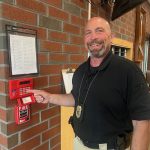
Michael Parlak, the director of security for Connellsville Area, said the district has panic buttons on alarm panels in all of the district’s schools. When pressed, a signal is sent to the district’s alarm company, which relays the signal to 911.
Parlak was hired as director of security in 2007, and said the panels were already in place. During his tenure, some have been upgraded or replaced to be more effective and take advantage of new and improved technology.
Bethel Park School District uses an app that allows faculty or staff to report emergencies, said Superintendent Dr. James Walsh. He was unsure when the district implemented the measure, but said it was already in place when he was hired in 2021.
Parlak called the safety measure a “no brainer,” and Walsh agrees.
“With the technology available, it makes complete sense in terms of safety and security and reducing response times,” Walsh said.
In Washington County, Bentworth School District Superintendent Scott Martin said he supports making schools safer, but would also like to focus on proactive measures.
Martin said the FBI has a saying: “What happens before the bang?”
He’d like to see more resources for school districts, including grant funding for mental health initiatives that could curtail issues before they get to the point of violence.
Bentworth has 10 mental health counselors to assist its 1,150 students, he said. Their focus is to build relationships with students to get them help before it comes to violence.
But, as the House Education Committee ponders the bill, Parlak questioned whether installing panic buttons would be affordable for all districts.
It’s a concern that state Rep. Charity Grimm-Krupa shares. The Fayette County Republican questioned if panic alarm systems would be an unfunded mandate – meaning school districts would have to find a way to pay without help from the state. In a time when many districts are already cash strapped, that burden would likely fall to taxpayers, she said.
A panic alarm system in Florida was estimated to cost between $2,000 and $8,000 per year, but lawmakers there earmarked $8 million to cover the costs.
State Rep. Bud Cook, a Republican who represents all of Greene County and a portion of Washington County, said he supports the bill.
“Our number one asset is our youth and (we should do) anything we can do to protect them and make sure that the facilities they are in (are) protected,” he said.
As violence in schools increases, Parlak said school officials must try to strike a delicate balance between keeping schools secure and maintaining a comfortable, nurturing space for students.
“If I had unlimited resources, I could make it so every school was practically impenetrable,” he said. “But then, it’s not a school anymore.”