

Reschenthaler, Bradstock vie for 14th Congressional District seat
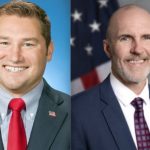
EDITOR’S NOTE: This is one in a series of stories featuring key races in the upcoming Nov. 3 election.
At the approach of elections in even-numbered years, political prognosticators eye all 435 congressional districts throughout the country, and make forecasts on whether they are “Solid Republican,” “Solid Democrat,” lean in one direction or the other, or are toss-ups.
Pennsylvania’s 14th Congressional District, which encompasses all of Washington, Greene and Fayette counties, and portions of Westmoreland, Indiana and Somerset counties, has been falling into the “Solid Republican” column, and that has remained the case this year, despite what is generally considered to be a challenging national political environment for the GOP.
U.S. Rep. Guy Reschenthaler has been able to hold onto the seat since he won it in 2018 without having to put up much of a fight. In 2020, he won 64% of the vote against his Democratic opponent, and 66% in 2024. In 2022, Democrats did not field an opponent against him.
The 43-year-old Peters Township resident is the chief deputy whip for the Republican majority in the House of Representatives. He served in the Pennsylvania Senate for three years before heading to Washington, D.C., and was also a magisterial district judge.
Reschenthaler’s Democratic opponent in the lead up to the vote Nov. 3, Alan Bradstock, is a retired FBI special agent and veteran of 1991’s Persian Gulf conflict. He is a native of Donora and now resides in Fayette County’s Dunbar Township.
Both campaigns were sent requests by the Observer-Reporter and the Herald-Standard for biographical information, and were asked to answer the same three questions. Reschenthaler’s campaign did not respond.
Name: Alan Bradstock
Age: 62
Residence: Dunbar Township, Fayette County
Occupation: Retired FBI Special Agent; U.S. Army veteran
Question 1. Data centers have been a source of community concern and controversy in this and other regions. Do you believe federal regulation of data centers is needed?
Yes. Data centers can bring jobs and tax revenue, but right now our communities carry the risks while developers keep the rewards. Zoning belongs to local officials, and Fayette’s commissioners are right to listen on setbacks and noise. But the power grid and electricity markets are federal responsibilities, and Washington has to act:
– Make data centers pay the full cost of the power plants and transmission they need, so household bills don’t subsidize them. The House passed the bipartisan Ratepayer Protection Act 417-3. The Senate should finish the job and strengthen it.
– Require public reporting of water and energy use.
– Set federal minimum standards for noise and backup-generator pollution.
– Make sure promised jobs are real, local and union-built.
Question 2. Everyone says they want to bring down costs. What concrete steps can be taken to accomplish this?
Here are my proposals to bring down costs:
– Health care: Restore the enhanced Affordable Care Act tax credits that expired this year and sent premiums soaring for Pennsylvanians. Expand Medicare’s power to negotiate drug prices and rein in pharmacy middlemen.
– Energy: Stop data centers and other big users from shifting grid costs onto households, and build more power (Pennsylvania natural gas, nuclear and renewables) to bring prices down.
– Trade: Replace across-the-board tariffs, which act as a tax on families, with targeted enforcement that protects American steel and manufacturing jobs.
– Groceries: Enforce antitrust laws against price-gouging by the handful of giant meatpackers and food companies that control the market.
– Housing and child care: Expand the Low-Income Housing Tax Credit to build more homes, and increase the Child and Dependent Care Tax Credit.
Question 3. There has been a measles outbreak across much of Pennsylvania, and it includes counties that are part of the 14th Congressional District. Do you think the current administration’s approach to vaccinations and public health is correct? What would you change?
No. Pennsylvania has more than 1,300 measles cases this year, with 251 hospitalizations and five deaths. Fewer than 1% of cases were in vaccinated people. The outbreak has reached Washington County, and some schools in our district have kindergarten vaccination rates below the 95% needed to stop the spread.
Measles was declared eliminated in the United States in 2000. It came back because confidence in vaccines was undermined. This administration has made that worse by cutting the childhood vaccine schedule without review by CDC scientists or a public hearing, and by floating the idea of splitting up the MMR shot.
Here’s what I would change:
– Restore an independent, science-based process for vaccine recommendations, with real public review.
– Guarantee that recommended vaccines stay free through insurance, Medicaid and the Vaccines for Children program.
– Fund local health departments and rural clinics so families can get shots close to home.
– Back doctors and nurses, the most trusted voices, in talking with parents.