

Carnegie Museum of Natural History curator leads discovery of new dinosaur species
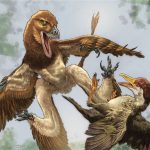
Carnegie Museum of Natural History’s curator of vertebrate paleontology and senior dinosaur researcher Dr. Matt Lamanna, alongside a team of researchers, has identified a new predatory dinosaur species from northwestern China, marking the first time a non-avian dinosaur has been discovered at one of the world’s most important fossil bird sites.
The newly named species, Jian changmaensis, belongs to the Microraptorinae – a group of small to medium-sized, feathered theropod dinosaurs colloquially known as microraptors that are closely related to velociraptor of “Jurassic Park” fame. Some microraptors had long feathers on both the fore and hind limbs and may have glided. Discovered in the Changma Basin of northwestern China’s Gansu Province, Jian changmaensis is the first definitive microraptor found outside northeastern China and may be the geologically youngest known member of its group, indicating that microraptors survived longer than paleontologists previously realized.
The fossil-consisting of a rare, three‑dimensionally intact shoulder and forelimb skeleton-was collected by an international research team that included Lamanna.
The discovery of Jian changmaensis provides insight into the origin of birds, as this dinosaur is one of the closest known non-avian relatives of the more than 10,000 bird species on the planet today. It is also the first non-avian dinosaur known from the Changma Basin, an exceptionally important fossil bird locality, thereby enhancing paleontologists’ understanding of avian evolution during the Age of Dinosaurs by adding a crucial non-avian perspective to the site’s fossil record.
“For decades, the Changma site has been renowned among paleontologists for its extraordinary bird fossils,” noted Lamanna. “Now, with the discovery of Jian, we finally know what was eating them.”
Dating to about 120 million years ago, during the early Cretaceous Period, Jian changmaensis offers rare anatomical preservation that may help scientists better understand how powered flight evolved in birds. Most microraptor fossils discovered to date were unearthed flattened, limiting their usefulness for studying wing motion and shoulder mechanics.
“This remarkable discovery represents a meaningful contribution to our understanding of life on Earth,” said Dr. Carey Miller, interim director of Carnegie Museum of Natural History. “Carnegie Museum of Natural History stewards one of the most scientifically and historically significant dinosaur fossil collections in the world, and each new species we uncover deepens our knowledge of the natural world – shedding light on our planet’s distant past while sharpening our responsibility to steward its future.”