

Westmoreland Museum of American Art unveils ‘Play Ball: The Art of George Sosnak’
Gone are the days when art museums catered solely to the elite.
Today, museums are embracing a refreshing trend by opening their doors to a broader audience through engaging and relatable exhibits. The Westmoreland Museum of American Art’s “Play Ball: The Art of George Sosnak” is just one example.
Sixty-one intricately decorated baseballs celebrating America’s favorite pastime will be on display at the museum through next April.
For the love of the game
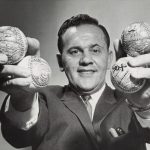
Born in Pittsburgh in 1924, George Sosnak was an umpire for minor league baseball teams, a baker, a corrections officer and self-taught artist whose love for baseball inspired him to transform ordinary baseballs into works of storytelling art with portraits, statistics, highlights and autographs.
A fan inspired the first work when she approached Sosnak after a game he umpired, asking him if he could draw a portrait of her favorite player on a ball. That single event launched his artistic career.
Sosnak was said to be fond of unusual plays, milestone hits, quirky trades and human interest stories.
“Some were commissioned and others gifted to people, players and fans,” said Dr. Erica Nuckles, director of learning, engagement and partnership at the Greensburg museum.
Sosnak, who died in 1992, was a prolific artist who began work on more than 3,000 baseballs over his lifetime. He used India ink for line work and lettering, acrylic or enamel paints for color and occasionally markers, dyes, or mixed media finishes.
“He completed about 800,” Nuckles said, noting that many in the exhibit reveal various stages of completion. “Visitors will see the evolution of his work, which became more colorful after the 1950s.”
What impressed Nuckles most was Sosnak’s steady hand.
“There is such great detail on them and over time they became even more intricate as he began using a magnifying visor. We’ve provided magnifying glasses for our visitors to view them up close,” she said.
Visitors will also see how the Pittsburgh Pirates logo evolved over the decades, along with baseballs honoring Roberto Clemente and the late Bill Mazeroski, whose walk-off home run in Game 7 of the 1960s World Series against the New York Yankees remains the only Game 7 walk-off homer in World Series history.
Another baseball commemorates the Hanshin Tigers and their visit to Detroit.
“It’s wonderful folk art that evokes a sense of nostalgia,” Nuckles said.
Some pieces resemble baseball trading cards and many incorporate player autographs. Sosnak often traced over signatures to help them stand out.
Baseball ephemera is also on display and includes letters to players and organizations.
“When he would send letters, he would cover the envelopes with art,” Nuckles said.
An interactive part of the exhibit enables visitors to design their own baseball artwork.
“We supply a piece of paper printed with a baseball outline so guests can create their own designs. They can then take the work with them, or display them in the visitor art gallery,” Nuckles said. “It’s really interesting to discover the artists among us.”
Connecting with audiences
Nuckles notes that now is a great time for the exhibit to be presented, since it’s in the midst of baseball season.
“This region is crazy about sports and Sosnak himself was a big Pirates fan,” she said.
The exhibit is part of a larger initiative aimed at finding different ways to connect with audiences.
“Last summer we featured an art maze with murals inspired by artworks in the gallery,” Nuckles said. More recently, the museum unveiled a mini golf exhibit with each hole inspired by an artwork.
“It’s an interactive exhibit, and what we’re witnessing is record attendance due to these initiatives,” she said, adding that studies show that once visitors come to the museum, they are likely to return.
Nuckles noted that Sosnak’s family attended the opening and believes he would be proud of the response his art is receiving.
“Sosnak combined his passion for the game with his urge to create,” she said. “The result is artwork that helps us trace the history of baseball in America over his lifetime.”
For more information on the exhibit, go online to thewestmoreland.org or call 724-837-1500.