

The Whiskey Rebellion explored in public television documentary
Alexander Hamilton is the subject of a monster musical, a best-selling, door-stopping biography and is considered an American martyr of the first order after dying at the hands of the dastardly Aaron Burr.
It’s probably fair to say, though, that some farmers in this region had the same lethal designs on Hamilton well before Burr actually carried out the deed.
They were the farmers who were about to be slammed by the tax on distilled spirits masterminded by Hamilton to pay off debts from the Revolutionary War. In Hamilton’s view, debts would be paid to “the lending class,” and these well-heeled individuals would lend the government more and more money for other endeavors.
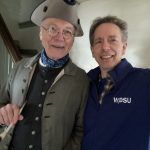
“This is how you build nations,” explained Kristian Berg, a producer at WPSU-TV, the Penn State-affiliated public television station. “This is the kind of government we ended up with.”
Those farmers who were about to have their livelihood strained by what they saw as a clear-cut case of taxation without representation were at the heart of the Whiskey Rebellion, the three-year tax uprising against the federal government that is a key moment in the United States’ early history and an essential part of regional lore.
The Whiskey Rebellion has been on Berg’s mind quite a bit over the last year or two, thanks to the 30-minute documentary “The Whiskey Rebellion,” which he created for WPSU-TV. It is currently available to be seen online through the PBS app, and will be screened at Washington & Jefferson College’s Rossin Campus Center Ballroom Sunday at 2 p.m.
Narrated by Peter Coyote, the actor who has been the voice for some of Ken Burns’ mammoth historical series like “The Vietnam War,” “The Dust Bowl” and, most recently, “The American Revolution,” “The Whiskey Rebellion” takes a comparatively quick trip through the conflict. A seasoned documentarian and a veteran of public television, Berg pulled together “The Whiskey Rebellion” with an eye toward the celebrations of America’s 250th anniversary this summer.
“I’ve been pushing for the Whiskey Rebellion,” Berg explained over the phone from State College recently, saying that despite its rancor it “strengthened the national identity.”
The first email he sent about “The Whiskey Rebellion” goes all the way back to 2015. Ultimately, Berg said, “A lot of stations liked the Whiskey Rebellion as an idea.”
The work of the 67-year-old Berg has taken him as far afield as Kazakhstan and Tahiti and led him to tackle such diverse subjects as farm foreclosures and the Nuremberg trial of Nazi war criminal Adolph Eichmann. For “The Whiskey Rebellion,” Berg obviously could not turn to photographs or films, since both mediums were decades away from being born at the time of the Whiskey Rebellion. He did, however, rely on some art that’s been inspired by the Whiskey Rebellion, including work by Canonsburg painter James Sulkowski, and reenactors who know the period. Members of the board of Washington’s Bradford House Historical Association appear in the documentary, as well as docents and volunteers at the Bradford House.
Berg himself also has a local tie to the Whiskey Rebellion – a great-great-great-great grandfather, Leverton Thomas, was part of the Whiskey Rebellion. Born in Wales, Thomas is buried in Pigeon Creek Cemetery in Eighty Four.
The Whiskey Rebellion “really was the event that shook the republic, but it ultimately strengthened it,” Berg said.
After the screening of “The Whiskey Rebellion,” Berg and historian Rob Windhorst of the Woodville Experience Museum in Heidelberg will take questions.
The afternoon will also have free tours of the Bradford House Museum until 6 p.m.; free tours of the Whiskey Rebellion Education and Visitor Center until 6 p.m.; and a complimentary whiskey tasting by Liberty Pole Spirits at the visitor center until 6 p.m.
Admission is free, but registration is required at BradfordHouse.org/events.