

Albert Gallatin to consider combining middle, high schools
Move could save up to $4.7 million annually
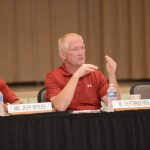
The Albert Gallatin School District will look at the costs of closing both middle schools and assigning students to the high school building as a possible prelude to wider consolidation of buildings in the district.
The board voted 6-0 Thursday night to direct the administration to set up interviews with
Superintendent Christopher Pegg and architects or value engineers to get cost estimates to modify the high school, which would be expanded to include students down to either sixth or seventh grade.
The district would also devise a financial plan and propose a timeline for phased consolidation.
Additionally, the board approved making video recordings of its meetings available to stream later on the district’s webpage.
“We need to do phase one, get the cost, everything else that occurs with that, move on with that, and then once that’s completed, that’s when we start looking at discussions and meetings with phase two, phase three, or whatever we need to do with it,” said President Jeff Myers.
Tuesday’s meeting followed one last week where the board and public also discussed options for consolidating buildings.
If all phases go as planned, the district would have three elementary schools, down from five, and the combined middle school-high school complex, instead of two separate middle schools.
Talk at last week’s meeting centered on closing Smithfield and Friendship Hill Elementary Schools starting with the 2027-28 school year, and combining them with Albert Gallatin South Middle School until construction finishes at the high school.
Once construction is completed, the next to close would be Plava and Masontown elementary schools, which would send most of their students to Albert Gallatin North. A.L. Wilson Elementary would remain open.
The combined building consolidations could save the district up to $4.7 million annually, Pegg said.
At the combined middle-high school, the younger students would be in a separate wing, have their own lunch period, and have a separate gymnasium, Pegg said. The new construction could also potentially house a central office.
“At this point this has been all discussion,” he said. “No decisions have been made until we get the cost for all of that to see exactly what the district can afford to do. One thing I think we all agree on is we cannot afford not to do anything and stay status quo. We would not survive financially.”
The board voted 5-4 in February not to schedule a public hearing on potential building closures for the 2026-27 school year.
To close what was forecast as a budget deficit of $1.5 million to $2 million, the board voted in April to furlough up to 30 teachers and support staff.
Of that group, the district was able to rehire three teachers due to enrollment increases and other teachers taking leaves of absence, Pegg said after the meeting. Teachers certified in those areas were recalled in order of seniority.
Mike McCaig, managing director in the municipal finance department of Raymond James, told the board Tuesday it could potentially borrow up to $50 million while keeping its debt service payments at the current level of $3.9 million.
If the board approves borrowing, McCaig said, they would start with a $10 million bond, then add up to $10 million more each year as needed. By borrowing that amount or less in a calendar year, under federal tax code the district would qualify for a better interest rate and better options for refinancing debt.
McCaig said the borrowing would be paired with a restructuring of the district’s current debt that would lower payments by almost $2 million in the new fiscal year.
A debt resolution could come before the board at its regular meeting on July 15, McCaig said.
About 25 people attended Tuesday’s meeting. Residents who talked during an informal question-and-answer session before the meeting adjourned said they worried about taking on too much spending with a declining revenue base, while also saying they would prefer to keep sixth grade with the elementary school.
Justin Moccaldi of Springfield said after the meeting he didn’t know if the general public appreciates the size of debt payments, saying “you’re paying back $80 million to get $50 (million) now.”
He didn’t like the idea of a combined middle and high school, or having middle school students share a bus with high-schoolers. Moccaldi also hated to lose the Friendship Hill and Springfield schools.
“There’s been a school in Smithfield for over 200 years, as far as I know,” he said. “It’s one of the best, if not the best, consistently performing school in the district.”
Ashley Raymond of Smithfield said she hopes “that they keep the students at the center of their decision, and they make the right choice for what’s the best for them, and not for what’s best for the people sitting at the table right now.”