

MOA sues PennDOT, DEP, claiming roadwork damaged Ten Mile Creek in Marianna
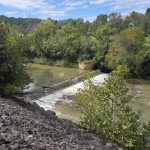
More than a decade after a project was completed to stabilize the hillside holding up Main Street in Marianna, the local outdoors club is suing the state’s transportation and environmental agencies claiming the work damaged Ten Mile Creek.
The Marianna Outdoorsmen Association filed the lawsuit Sept. 17 in Commonwealth Court against the Department of Transportation and Department of Environmental Protection, accusing them of violating the state’s Clean Streams Law.
The lawsuit contends PennDOT’s “ill-conceived attempts” to stabilize Main Street in the Marianna area in 2016 eventually caused damage to the creek, with riprap and other material placed on the hillside ending up in the waterway below. The work caused the “degradation of the formerly pristine portion of Ten Mile Creek” that has contributed to a loss in revenue for the MOA and neighboring communities that use the waterway for recreation near the Marianna Dam, the lawsuit alleges.
The MOA held its annual “Anything That Floats” race down a 3.2-mile portion of the creek near that area beginning in 2007 with just 17 racers and increased to 250 participants during its final year in 2018, raising about $50,000 annually.
In June 2016, the MOA received a letter from DEP that PennDOT had submitted a general plan to stabilize a roadway near Ten Mile Creek, including an area the non-profit leased from Marianna Borough. Club members raised concerns about how the project might impact the stream with rocks used on the hillside likely sliding into the stream, but PennDOT proceeded with the work.
“When this situation happened, PennDOT did not follow their approved permits,” said Jason White, who is executive director of the Marianna Outdoorsmen Association. “This is why it’s discriminatory. If this was you or me or a private business that did this, we would have been pinned to the wall in a major, major way.”
Failures along the hillside in the winter of 2016 and summer of 2017 caused riprap – which are large rocks meant to stabilize hillside areas – to slide into the creek nearly all the way across, which eroded the banks and damaged portions of the waterway, the lawsuit states. PennDOT later removed some of the excess riprap – but not all of it – and the creek remains damaged, MOA claimed in its lawsuit. The lawsuit claims the initial permitted activity was destined to fail, and additional work that did not comply with the original permit contributed to the problems.
“As a direct result of this activity by PennDOT – which decimated a portion of Ten Mile Creek – MOA was forced to permanently cancel the Annual Anything That Floats Race (given that this portion of Ten Mile Creek no longer has adequate streamflow to support the watercraft and given that significant streambank erosion has made for unsafe conditions),” the lawsuit states.
DEP inspected the roadway stabilization work and deteriorating conditions on Ten Mile Creek in April 2025, and gave PennDOT 15 days to develop a plan to “shore up” the bank and remove the riprap from the stream, the lawsuit claims. But no comprehensive plan was ever developed, according to MOA, and the organization moved forward with a notice intending to sue last July before filing this lawsuit in Commonwealth Court last week.
The lawsuit claims the DEP has ignored other issues involving other entities along Daniels Run and Ten Mile Creek. White said they have been forced to move their activities and events to other places on Ten Mile Creek due to the damage near the dam.
“From Day 1 that this happened, it’s been complete negligence of accountability by the DEP. There’s been no uniformity,” White said. “The canoe race getting destroyed – and that was a centerpiece to this – but there are major other implications that have opened up, kinda like Pandora’s Box. … Because it’s never been fixed, it’s an ongoing illegal activity. It’s never been rectified or resolved.”
When MOA attempted to undertake a project to restore the creek, the organization was required to go through multiple permit reiterations and requirements outside the scope of normal regulations and guidance. The lawsuit states that the DEP has an “inconsistent, piece-meal enforcement and compliance with the statutory and regulatory obligations” that are designed to “preserve and protect recreational waterways” such as Ten Mile Creek.
“It’s not uniform how (similar issues are) handled across the state,” White said. “It’s a complex case, but one that will have statewide implications.”
A PennDOT spokesperson said Wednesday that the department had not yet been served with the lawsuit, and an email sent to the DEP did not immediately receive a response.
The MOA is asking for declaratory judgement and injunctive relief, requiring PennDOT and DEP to reimburse MOA for lost income and fees while also forcing the state agencies to take steps to fix the issues associated with the stabilization project. The outdoorsmen club is being represented by attorney Brandon Coneby of Peacock Keller.