

Walk on the Wild Side
Hike in local parkland leads to amazing encounters
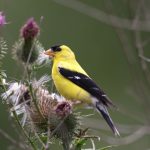 Photo courtesy of Pennsylvania Game Commission
Trails at Fort Necessity National Battlefield in Farmington offer a convenient and appealing place for exercise. The battlefield’s paths traverse meadows and woods just as George Washington’s little army did in his 1754 campaign that kindled the French and Indian War.
For a 3-mile workout, I like to start at the visitor center parking lot, follow the asphalt road to the top of the hill, then circuit the dirt-road loop at the picnic area. That brings me back to the paved circle at the hilltop, where I strike west on the Outer Loop to return to my vehicle. A bonus of this trek are wild encounters along the way.
Last week, those encounters were more frequent and unusual than expected.
Deer crossed the road near the hilltop circle. Not unusual. There were five, looking burnished in their red summer coats. Two mid-size yearlings led, followed by a mature doe and her two fawns, gamboling behind. Their white spots glowed in the sun at the road crossing, then blended with dappled light and shadow when they plunged into woods. Ideal camouflage for such vulnerable wildlings.
Just beyond the picnic area, the dirt road skirts a stand of big white pine, planted by the Civilian Conservation Corps’ Fort Necessity Camp back in the 1930s. Ravens often flock in those pines, and they were there, croaking and grunting from unseen perches in the crowns. I paused to try and spot one, but saw a different bird perched motionless against a pine trunk. It was a barred owl, staring back with a haughty glare. I think of the barred owl as the most observable of our seven resident owl species. I’ve seen them perched in daylight several times.
The Outer Loop Trail heads west through old fields blazing at this season with summer flowers. Goldenrod is just beginning to blush, while thistles, milkweed, butterflyweed, ironweed, black-eyed Susan, and wild bergamot all spatter color across the slopes. A flock of American goldfinches were inspecting the thistles, searching for early seeds. Their short undulating flights among the blooms displayed their gleaming yellow plumage to its best effect.
Banks of lavender-hued wild bergamot massed among the thistles. Three ruby-throated hummingbirds, two males with iridescent red throats, and one less gaudy female, probed the tube-like flowers. Bergamot is one of the wild mints, and its spicy fragrance is as pleasing as the sight of its shapely pale-violet blooms.
Farther on, the trail skirts another old field where the National Park Service has managed to curtail the spread of invasive honeysuckle, so that native poplar, cherry, and oak are reclaiming the site. Park Service staff mow the trail here, about five feet wide. A small dark creature shot onto the path, paused for a just a heartbeat, then dove into the foliage on the opposite edge. It was a long-tailed weasel, an efficient predator of small birds and mammals up to rabbit-size. Later, I checked my list of observed mammals in my copy of Peterson’s Field Guide to Mammals. I had checked off “long-tailed weasel” sometime in my past but, disappointingly, hadn’t noted the date or place. So, this latest weasel sighting felt like a first.
At its extreme southwestern corner, the trail approaches Timber Rock Park and Amphitheater, then angles sharply north to return to the fort. I rounded a curve and saw a large coyote trotting toward me along the mowed path. Its gaze was downward as it sniffed the grass. Often, I’ve seen a rabbit munching clover in that same spot, so guessed the coyote knew about that cottontail too. But a second later the ‘yote looked up in surprise at my presence. It turned and streaked away, glancing back once over a churning shoulder.
A little past the coyote encounter, I heard the goldenrod rustling to the right of the trail and couldn’t suppress a thought: “I hope that coyote’s not following me,” because you sometimes read about such unusual behaviors. I stopped to assess the disturbance.
A snarl of blackberry grew there among the goldenrod, its canes thrashing and jostling from some assault on their fruit. The jostling suddenly ceased and a black bear stood erect in the thicket, 40 feet away, as surprised to see me as I was amazed to see it.
The bear dropped to all fours and crashed away. Its exit suggested a runaway Volkswagen plowing through the foliage. It was only the third bear I have encountered in many years of exercise hikes at Fort Necessity.
We are fortunate to have public lands like Fort Necessity National Battlefield so convenient to visit in our region. September is just around the corner, designated “Public Lands Month” in America. Enjoy, and value, our public lands to celebrate their irreplaceable contribution to American life. Entry is free, there’s seldom a crowd, and the experience can be unforgettable.
Ben Moyer is a member of the Pennsylvania Outdoor Writers Association and the Outdoor Writers Association of America.