

November Roulette
 Ben Moyer
It’s a sign of autumn as sure as falling leaves, but less obvious to a motorist’s view. Deer are on the move and their roving peaks in November.
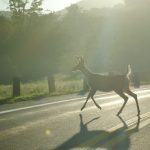
This is the white-tailed deer mating season-known as “the rut”-and it changes a lot about deer behavior. Normally secretive and nocturnal, for these few weeks in late-fall deer go, well, daft-especially the bucks (males). When a buck sniffs the airborne scent of a doe nearing her reproductively receptive stage, every other concern vacates his skull. During the rut, bucks chase after does with abandon, ignoring humans, hunting blinds, and highways. If a doe crossed a road within the past few hours, bucks are going to follow, blindly, at any time of day. That’s why drivers need to be doubly alert, driving through deer country in November.
By the way, “deer country” doesn’t mean what it once did. Not so long ago, whitetails were confined to mountain woodland. Nowadays, you’re as likely to brake for deer in the suburbs as the backwoods. Deer have adapted to the human-altered landscape, but they never got the memo about road-kill. They don’t look both ways.
Drivers around here are among the most likely motorists in the nation to collide with a deer. According to the Institute for Environmental Research and Education (IERE), Pennsylvania drivers hit more deer than motorists in any other state. The State Farm Insurance Co. reports about 150,000 claims filed in Pennsylvania every year due to deer collisions. A map on one of State Farm’s websites shows Pennsylvania in green with red swaths where the probability of striking a deer is greatest. A big red blob surrounds Pittsburgh, then extends south up the Mon Valley, swells eastward to Uniontown and bleeds south into West Virginia.
Most of those 150,000 impacts end up with a smeared deer carcass and crushed fender, but some are far worse. PennDot’s 2022 data document that 5,848 deer-collisions resulted in a serious accident that year, in which 1,264 people were injured and nine lost their lives.
Western Pennsylvania drivers can’t improve their odds by driving to Morgantown or points south. On a statistical basis, driving in West Virginia is even riskier. State Farm says that the odds of hitting a deer in West Virginia are 1 in 46-highest in the nation. I guess that means, statistically speaking, that if you make 46 car-trips, you’ll hit a deer once. On this scale, Pennsylvania ranks fourth in the nation (1 in 64) behind West Virginia, Montana (1 in 54), and Wisconsin (1 in 62).
The only way I can make sense of Pennsylvania’s having the most deer-collisions of any state, yet ranking fourth in probability is that Pennsylvania has more drivers, spreading the risk among more people.
Another factor that makes November so risky is that we hunters are in the woods then. And when humans are moving around in deer habitat, deer go the other way, sometimes onto a road.
“The rut is an exciting time for hunters but needs to be a time of heightened awareness for drivers,” said Game Commission Executive Director Steve Smith. “Whitetails are ramping up their activity levels and expanding their home ranges, so it’s imperative that motorists exercise increased caution and attentiveness during this time of year.”
You never know where or when a deer will suddenly vault into your path, so caution is always warranted. There are two places, though, where this writer has noticed a definite amplified danger. These are that flat, straight stretch of Rte. 40 passing Fort Necessity National Battlefield, where deer cross frequently and the blinding-bright sign of a neighboring church makes it harder to see them on the road ahead, and the section of Rte. 21 flanking the former Springdale golf course. I hit two deer there within a week.
It’s good manners and a safe practice to avoid tailgating the vehicle ahead. That etiquette is doubly important in places such as those noted above where deer are known to cross the highway often. Tailgaters seem to assume that nothing unexpected can happen in the path of that car they’re tailing. But when a deer darts into the road, that leading driver needs, and deserves, room to brake without getting rear-ended.
You can reduce your PA-rated 1-in-64 odds of hitting a deer by simply slowing your speed. Frequently glancing along the roadsides can let you see that approaching deer a little sooner, allowing time to break. And when one deer crosses ahead, always assume that others will follow and slow down. It can save a damaging and dangerous impact.
A driver who hits a deer with a vehicle is not required to report the accident to the Game Commission. If the deer dies, only Pennsylvania residents may claim the carcass. To do so, they can call the Game Commission at 1-833-PGC-HUNT or 1-833-PGC-WILD and an agency dispatcher will collect the information needed to provide a free permit number, which the caller should write down. A resident must call within 24 hours of taking possession of the deer. A passing Pennsylvania motorist also may claim the deer, if the person whose vehicle struck it doesn’t want it.
We’re fortunate to have the beauty and grace of white-tailed deer as part of our daily lives. But those graceful creatures can turn your day, or night, bad in an unexpected hurry. Stay alert always on the road, especially in November.
Ben Moyer is a member of the Pennsylvania Outdoor Writers Association and the Outdoor Writers Association of America.