

To the point
Antlers, coveted by hunters, are important social signals among deer
 Ben Moyer
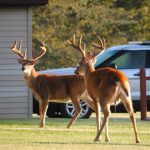
It may be the most acclaimed one percent in all the outdoors. A nice rack of antlers on an average-size whitetail buck generally represents about one percent of the animal’s weight. Yet those slender bony arcs attract all the attention. Possessed only by the males of the deer family (Cervidae) including deer, elk, and moose, antlers have entranced humans for thousands of years. Caribou are the lone exception among deer. Caribou of both sexes grow antlers.
Fascination with deer and their antlers will motivate about 600,000 Pennsylvania hunters starting Nov. 28, when the state’s regular firearms deer season opens. The season will end Dec. 13, Sundays included. In addition to antlered bucks, hunters may take an antlerless deer with each valid antlerless license they possess.
“We can trace fascination with antlers back to cave paintings and pictographs anywhere that deer and humans have lived together,” said Kip Adams, a certified wildlife biologist and chief of conservation for the National Deer Association. “Antlers may have been esteemed back then as a symbol of vitality and health. In those depictions, antlers are often exaggerated in size, and we hunters sometimes tend to continue that today.”
But if antlers are objects of fantasy for hunters, they are serious seasonal accessories for deer. Grown anew each spring and summer, antlers are part of the complex interaction among deer every autumn for dominance among rivals and breeding access to does.
“There is no question that impressive antlers can help a buck win high status if he encounters another buck of similar size and weight,” Adams said.
Spurred by hormonal response to longer periods of daylight, antlers begin to grow from bony “stumps” known as pedicels in mid-April. As the new antlers grow and branch, a web of capillaries and veins deliver nourishing blood beneath specialized skin called “velvet.” Antlers grow until late August when shorter days trigger the velvet to dry, crack and peel. Even massive moose antlers spanning five feet reach their full size in one summer season.
Antlers are among the fastest growing tissues known to science, faster than cancer cells. The growing period is about 150 days long, so a buck whose rack measures 150 inches on the Boone and Crockett Club antler-scoring system would have grown more than an inch of antler a day.
If nutrition remains consistent through life, whitetail bucks grow larger antlers as they age.
“A yearling buck’s rack generally represents about 15-20 percent of its ultimate potential,” Adams said. “Whitetails do not reach that antler-development potential until age five to seven years.”
What’s known as a “typical” whitetail rack features a main beam that initially grows backward from the skull, then turns and arcs forward and roughly parallel to the snout. Tines or points, numbering generally from one six, branch upward from the main beam. Typically, whitetail tines are single points and do not branch.
Antlers of individual bucks, though, often deviate from the basic whitetail template, resulting in “non-typical” racks that attract special attention from hunters.
“Some non-typical traits, especially drop-tines that turn downward, can be genetic but the really bizarre racks you see are caused by injuries to the antlers during growth,” said Justin Spring, executive director of the Pope & Young Club, the nation’s foremost bowhunting advocacy organization. Spring is a former director of big game records for the Boone and Crockett Club.
Antler color is another topic that captivates hunters’ attention.
“When the velvet first comes off, antlers are pale white bone,” Spring explained. “By hunting season the color of a rack a hunter takes home is habitat-driven. For example, the antlers of Roosevelt elk from the Pacific Northwest are often tinted orange from rubbing on a species of alder native to their range.”
Bucks from western Pennsylvania woods might have darker antlers from rubbing on walnut, or the antlers may even carry a reddish tint if they have rubbed on black cherry saplings.
Spring acknowledges that hunters are naturally intrigued by a rack, but he adds that antlers are only one part of the complex social interplay among deer.
“There is more at work than just the antlers themselves,” Spring explained. “They are part of a sexual selection process. Antlers indicate that a buck has been able to glean adequate forage and nutrition from his environment. If a deer is undernourished, one of the first things it pulls from to sustain itself is antler development. If he’s getting enough to eat, he’s adept at surviving and the rack can show that.
“To win access to females, bucks do not display their antlers in a formalized posturing way as do wild sheep. With white-tailed deer it’s more a case of the buck chasing the doe for long periods. As a buck continues to chase a doe, she may select for him to breed because he’s indicated he will produce fit offspring.”
Adams agrees that other traits can trump antler size in the competition among rival bucks.
“Dominant status can be more indicated by body size,” Adams said. “Even temperament plays a part. I’ve seen some bucks dominate those with bigger antlers just because they have that attitude. Antlers are important social signals, or deer would not go to the metabolic expense to grow them, but they are only one part of the interaction.”
Most deer experts dismiss the importance of antlers as defensive weapons against predators. If antlers were important for defense from wolves or mountain lions, the females would grow antlers too.
Antlered bucks are legal game in Pennsylvania during the archery, regular firearms, and late flintlock seasons. But hunters may legally take only one antlered buck in a license year, regardless of season.
Ben Moyer is a member of the Pennsylvania Outdoor Writers Association and the Outdoor Writers Association of America.