

Rite of fire
Home-heating with firewood yields financial and personal rewards
 Ben Moyer
Autumn evokes strong feelings. Many people welcome fall’s colors, bracing air, and diverse outdoor options. Others rue the colder weather and shorter days. For a minority of Americans, autumn’s arrival means reacquaintance with firewood.
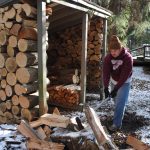
For an even smaller fraction, those who glean their own wood, they’ve been cutting, splitting, stacking, and seasoning firewood throughout the year. Wood is a lot more “hands-on” than fossil fuels you have delivered by truck or the electricity you summon by flipping a switch. Except for the pain of paying the bill, such handy heat is “out of sight, out of mind.” By the time a wood-user slips that satisfying slab of oak into the stove, they’ve probably handled it a half-dozen times and might even recall that individual piece’s journey from standing log to glowing ember. You form a cozy kind of bond with your wood.
As recently as the 1940s, most American homes were heated with wood or coal (coal burned directly, not to generate electricity). But what we perceived as convenience won over generations through the 1950s, 60s, and ’70s, and wood heating nearly disappeared.
Americans rediscovered firewood in the late 1970s after the oil embargo and our first energy crisis (more are likely on the horizon). Today, nearly 2% of American homes are heated primarily by wood, and about 8% of Americans use firewood to supplement another heat source in their homes.
The popularity of wood-heating varies around the country. Rural New England is the most wood-dependent region (14% in Vermont), while wood-heating is rare and declining in southeastern states. According to the Alliance for Green Heat, between 2000 and 2010 wood-heating increased by 34%, making firewood the fastest-growing heat source in America during that span. Pennsylvania is second in the nation, behind only California, in the total number of homes heated by wood. In 2024 over 111,000 Pennsylvania households burned firewood to keep warm in winter, just over 2%. Neighboring West Virginia ranks 7th in the proportion of homes heated with wood (4.9%).
Wood-heating has always been important in Scandinavian countries, some of the world’s most affluent and highly-educated societies. I’ve read that Norwegians and Swedes still take great pride in erecting their firewood stacks in artful ways. Many Scandinavians delight their neighbors and communities with creative firewood sculptures, which they dismantle during each winter’s burning.
Part of wood-heating’s appeal in our region is that we have the highest quality firewood in the world growing across our landscapes. All the native oak species, black cherry, the hickories, black locust, and some of the maple varieties are the envy of the wood-burning world. In Alaska, for example, rural residents must ward off sub-zero temperatures for months by burning spruce and birch, which are inferior fuels to our oaks and locust. A cord of dried and seasoned oak firewood, four feet by four feet by eight feet (128 cubic feet) yields as much heat as 200 gallons of heating oil. Seasoned hickory and locust yield even more. If you’re willing and able to invest “sweat equity” in your firewood, you can pay off the initial cost of installing a woodburning stove quickly with that kind of saving.
Sadly, we lost one of our most abundant and efficient firewoods over the past 15 years when the invasive emerald ash-borer beetle, accidentally introduced from Japan, killed every ash tree from the Great Lakes to the Gulf of Mexico. Ash yielded lots of heat, it was lightweight and clean-burning. Ash was also the favored wood for baseball bats. Its loss is tragic.
One of wood’s great advantages as a heating fuel is that it is a renewable resource. Unlike coal, oil, and gas, all of which are finite and require environmental disruption to extract, wood grows back perpetually. Every day through spring and summer as the sun shines on woodlands, trees build more wood tissue that can serve as a future heat source.
People often dismiss wood because of the labor and time required to get that payoff in winter heat. But many firewood enthusiasts relish the very demands that others deem unacceptable; they simply look at firewood’s “chores” from a different viewpoint. Labor becomes exercise, and the hours of “drudgery” required become time enjoyed outdoors, often with family and friends who share that enthusiasm for gathering renewable thermal energy from a natural, local resource. Wood isn’t practical for everyone, but if you have a source of wood nearby it can deliver personal satisfaction as well as warmth.
Good firewood does require work, but when my wife proclaims her delight in its cozy warmth on long winter evenings, the cutting, splitting, and hauling are forgotten, and I’m ready to lug in another armload of oak.
Ben Moyer is a member of the Pennsylvania Outdoor Writers Association and the Outdoor Writers Association of America