

Peeping by paddle
Explore lakes, streams of the Laurel Highlands for better view of fall
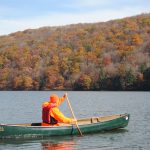 Submitted photo
I’ve never liked the phrase “leaf-peeping,” but it’s well entrenched now so we’ll go with it. Leaf-peeping refers, of course, to the popular diversion of savoring the beauty of fall foliage, which surrounds us in our region.
“Peeping,” though, doesn’t feel like the right word. It suggests a quick, furtive, almost creepy glance, which is not the way to appreciate this seasonal show. Gape or gawk are better descriptions because a hillside of tawny oaks and blazing maples can be so stunning that it’s hard to tear away your stare.
Most leaf-peeping is done from a car, where the phrase does fit because driving along a rural route the colors blur by the windows like a kaleidoscope in transition. Some people do their peeping from a hiking trail, the choices among which are endless here. Hiking to peep is great exercise but it has its limitations. Most of the time, on a hiking trail, you are hemmed in by the very foliage you hope to view-it’s a real-life example of the old “can’t see the forest for the trees” adage.
There’s another way to peep that combines exercise with wide-open views of the flanking fall landscape, at modest speed that lets you take it all in-peeping by paddle.
Our Laurel Highlands region has a wide menu of places where you can launch a kayak or canoe, then ogle the foliage from a waterborne perspective.
First, consider our rivers. Both the Youghiogheny and the Monongahela embrace sections officially designated as “water trails” through a cooperative effort of the Pennsylvania Fish and Boat Commission, Dept. of Conservation and Natural Resources, National Park Service, and Pennsylvania Environmental Council. Official water trails are stream/river sections with identified public access points where the paddling difficulty is rated so boaters can match their skills and limitations to conditions.
The Monongahela Water Trail extends from Point Marion downstream nearly to the Mon’s confluence with the Youghiogheny at McKeesport. Public launch ramps are located at Point Marion, Fayette County and Greensboro, Greene County.
Even though the Mon boasts a long industrial history, the flanking river hills are still mostly forested, and the vistas from the river in fall are breathtaking.
For casual leaf-peeping by paddle, you don’t need to get too ambitious. There’s a lot of distance between public access points, but you can enjoy plenty of peeping by returning to your launch point, rather than a downriver journey that requires shuttling by car. All paddling on the Monongahela is gentle “flatwater” with no rapids. Do not, however, approach any of the navigational dams that impound the river’s flow to accommodate barge traffic. These are genuine hazards for small craft.
The Youghiogheny is a designated water trail all the way from Confluence downriver for 76 miles to McKeesport. The Yough presents different conditions throughout its length, but the autumn scenery is unsurpassed, perhaps anywhere in the world.
The nine miles from Confluence to Ohiopyle (known as the Middle Yough) are generally considered an easy float, though I sense this section’s difficulty is sometimes “undersold” to beginners. There are rapids, but not threatening in a technical sense. Never paddle in high-flow conditions.
The Yough’s tumultuous section from Ohiopyle downriver to Bruner Run takeout is best left to guided trips and experienced whitewater paddlers. There’s not much time for leaf-peeping while shooting a Class IV rapid.
It’s on the “Bottom Yough” from Connellsville to Cedar Creek, West Newton and beyond where paddlers of all skill levels can enjoy the fall colors passing slowly by a drifting craft. There’s public access at Connellsville, Dawson, Perry Township, Smithton, Cedar Creek Park, and West Newton.
Lakes are another peeping option. A great destination is Laurel Hill Lake in Laurel Hill State Park at Trent, Somerset County. The park has two public boat launches, and the colorful heights of Laurel Ridge flank the lake throughout its length. The lake tapers inward and the views grow more intimate as you paddle “up-lake” toward the Laurel Hill Creek inflow.
Cranberry Glade Lake, a few miles northeast of Ohiopyle, is another mountain gem. Cranberry Glade is a public resource, managed by the Fish and Boat Commission. Fall colors are especially bright along the lake’s western shore, where the foliage blazes beneath the wind turbines that spin atop Laurel Ridge. Cranberry Glade Lake is the best option if you want to combine leaf-peeping with wildlife watching. In fall, waterfowl including wood ducks, mallards, and Canada geese are often present, as well as the commonplace great blue heron. Cranberry Glade is a likely place to have a bald eagle soar above your boat, and sometimes a beaver will swim beside your craft.
Virgin Run Lake near Perryopolis and Greenlick Lake in Jacobs Creek County (Fayette) Park are more places where a paddle can earn you good leaf-peeping.
It’s a wonderful time of year in a beautiful place on the Earth. Make the most of it this fall by paddling to leaf-peep.
Ben Moyer is a member of the Pennsylvania Outdoor Writers Association and the Outdoor Writers Association of America.