

Gold rush
Showy yellow blooms dominate region landscapes in late summer
Very soon, at 8 p.m. Sept. 22, Earth will reach one of two points in its orbit around the Sun when the lengths of day and night are equal at every point on the planet, the Autumn Equinox. But that equality won’t last beyond one day. Fortunately, Earth’s orbit never stops. So, after the momentary equinox, we in the Northern Hemisphere head into our time of longer darkness and brief daylight as our half of the planet declines increasingly away from the Sun.
We anticipate changes around us in response to this cycle. Nights chill and fog pools above rivers. Familiar birds leave us for warmer climes. Here, meaning the northeastern third of the United States, as in few other regions of the world, our most obvious change is the color of foliage on deciduous trees. Half a year’s green is briefly upstaged by scarlet, yellow, copper, and orange. It’s a spectacle to savor.
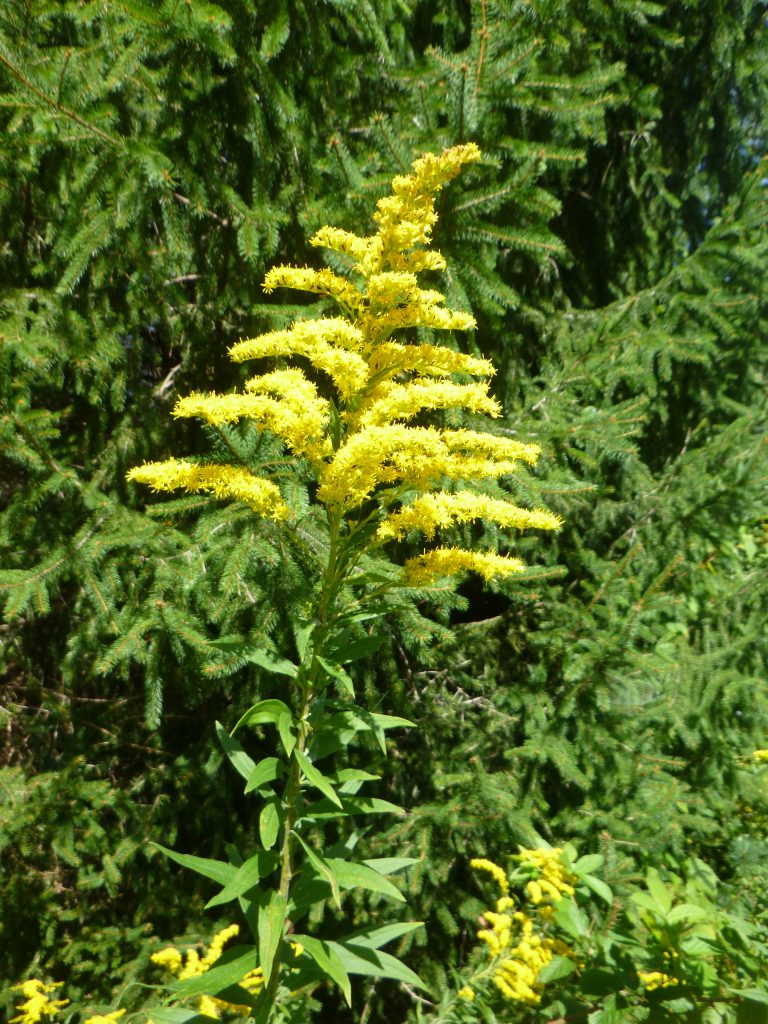
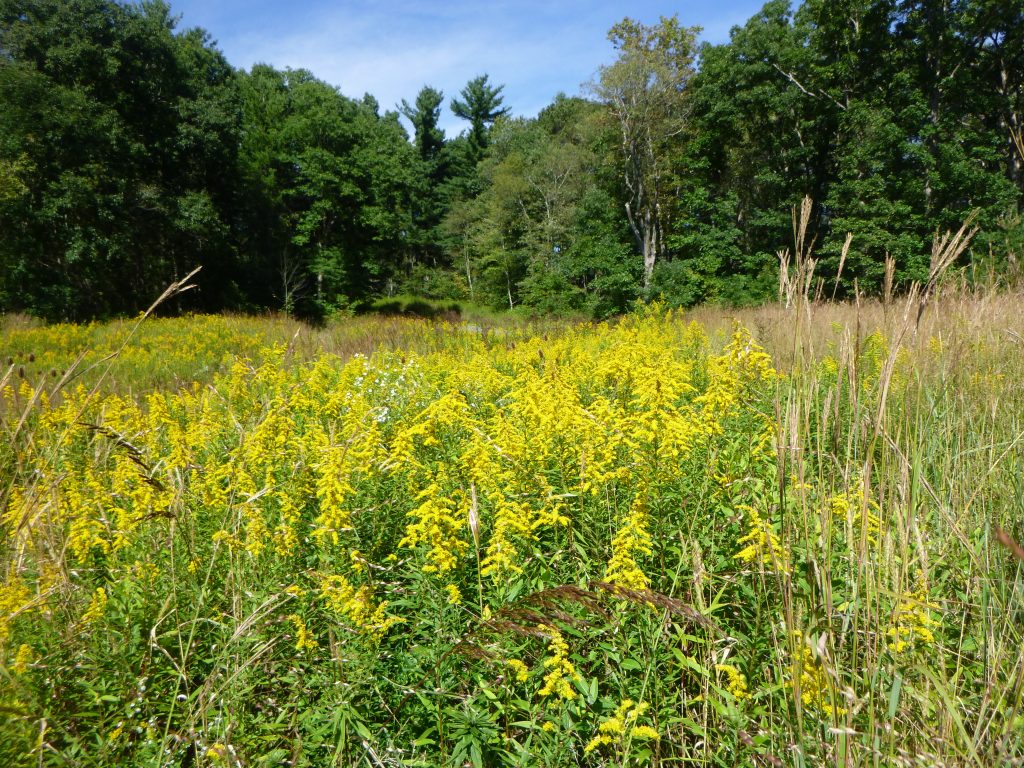
Yet, there’s another burst of color that precedes the blazing trees but goes mostly unnoticed, ironically because of its widespread abundance. This color is everywhere right now at summer’s end. It glows along roadsides, across whole fields and meadows, and gilds sloping pastures. It’s the rich-yellow of goldenrod, native plants that are both routinely common and amazingly diverse at the same time. Any shred of unused land that is not forest is shining in goldenrod at this season. Goldenrod presents a conundrum. They’re so common that we can’t miss them, but we seldom notice their presence.
Until that is, someone sneezes. Then goldenrod gets the blame, falsely, for causing hay-fever. This myth is rightly assigned to an entirely different plant–ragweed, which is related to goldenrod and blooms at the same time but is different in important ways. Ragweed’s lightweight pollen is wind-blown, which is why we encounter it far from its parent plant, so that its source escapes blame. Goldenrod pollen is heavier and “sticky.” It evolved to be moved about by insects. Ragweed’s flowers that produce its airy pollen are bland and unattractive, so when people start suffering allergic symptoms in late summer, goldenrod’s flaming yellow plumes get condemned, wrongly.
Goldenrods are amazingly diverse. Most botanical references recognize about 65 different species of goldenrod in the northeastern United States. The Atlas of the Flora of Pennsylvania documents 17 species in Fayette County alone, though there are likely many more.
All goldenrods flower at the same time in late summer, so that timing of bloom is not a reliable way to tell them apart. They all rush to flower and set seed in the brief time between mid-summer, when competing flowers attract pollinators, and the frosts of fall.
The easiest difference to see among the various goldenrod species is the shape of the flower-head. Most are “plume-like.” Some flower-heads are in the shape of a pyramid, triangular from the side-view. Others are slender wands of yellow. Some are “elm-shaped,” copying the classic shape of elm trees. Still others are “club-shaped,” while a few flower-heads take the form of a flat disc. But it’s important to know that the large showy “flag” of bright yellow is not the plant’s flower. That display is made up of dozens of tiny “true flowers” arranged within it in that species’ characteristic shape.
Some common species within these groupings are Canada goldenrod and tall goldenrod(pyramidal), bog goldenrod (plume-like), blue-stemmed goldenrod (wand-like), and lance-leaved goldenrod (flat disc). Only expert botanists can distinguish some of the closely aligned 65 species from one another.
Goldenrods seldom grow in woods. They like open, airy sites like meadows and abandoned fields. It’s primarily the availability of moisture that determines which species will dominate the site.
These common flowers are ecologically important. Many kinds of butterflies and bees visit goldenrod for its nectar, pollinizing the plants in exchange. Ecologists consider goldenrods to be “keystone species,” meaning that their presence holds local biological functions intact wherever they grow. They have been called the single most important group of plants supporting pollinator insect diversity in North America. Recently at Fort Necessity National Battlefield, I saw seven increasingly rare Monarch butterflies probing goldenrod flowers for nectar.
I was surprised to learn that goldenrod has, or had, an industrial use. Inventor Thomas Edison developed a process to extract the small amount of natural rubber present in goldenrod leaves. This work so impressed Edison’s friend, Henry Ford, that Ford gifted an early Model-T automobile to Edison with tires made from rubber extracted from goldenrod. Later, Ford teamed with horticulturist George Washington Carver to perfect the process which helped bolster the supply of rubber for Allied forces in World War II.
Look for blooming goldenrod anywhere and everywhere for the next few weeks. Even the most common things in nature lead compelling lives if we simply take notice.
Ben Moyer is a member of the Pennsylvania Outdoor Writers Association and the Outdoor Writers Association of America.