

Rodriguez pleased with College Sports Act progress
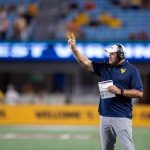 AP Photo/Scott Kinser
On Monday night, the Senate passed the College Sports Act with a vote of 77-22. This moves the bill to the House of Representatives, pushing it one step closer to one day becoming final.
The College Sports Act, led by Sen. Ted Cruz and Sen. Maria Cantwell, establishes guidelines regarding NIL, athlete compensation, transferring, recruiting, eligibility and more. It’s supported by President Donald Trump, legendary coach Nick Saban, and numerous athletic directors and head coaches across college athletics, including West Virginia’s Rich Rodriguez.
Rodriguez has been a firm believer in the College Sports Act since its inception, and was pleased to see it advancing through the federal government.
“I’m hoping it passes the House, and then you’ll get some sense of structure,” Rodriguez said. “If it doesn’t pass the House and it goes on, I’m telling y’all it’s a mess. Being a college fan, a college sports fan, I’m really concerned if it doesn’t pass the House because I think this will give us the structure we want.”
The bill is far from perfect, and Rodriguez has admitted that. But it creates some structure for the rapidly growing space of college athletics, especially the monetization part.
Before the bill passed, the Senate rejected an amendment that put a $5 million cap on coaches’ wages. College football coaches make millions of dollars, and many of them have close to $100 million buyouts. Rodriguez, who makes roughly $3.75 million a year, doesn’t want a cap on coaches’ salaries. But he sees the reasoning behind it.
“But I can understand where that argument is because where the money’s being spent,” Rodriguez said. “But I think in a free market society, I think it’s like with you all are getting paid, you can only get paid so much for your work. I think that’s a hard ask in an American society. But I also think the argument on the collective bargaining agreement and players having a little bit of a say in how the money or how much money is distributed to them, I could see that argument, too.”
Adding a collective bargaining agreement for the athletes is another topic of discussion that’s not included in the bill. Every major sport league — NFL, MLB, NBA, NHL — has some sort of CBA to set the terms and conditions between the owners and players.
There are multiple issues with a college CBA. For a start, there are no owners, unlike professional leagues. The universities are independent of each other, and there are so many at all sorts of sizes with different needs. With a CBA, too, athletes will be looked at as employees, and that doesn’t sit well with lawmakers based on the tax impact, and universities have to take on major costs because now all these college athletes are on payroll.
Rodriguez believes college athletes should be employees.
“Nobody wants to have them as an employee,” Rodriguez said. “I don’t know how a guy gets paid that much money, and he’s not an employee, right? Then if you’re an employee, you could probably have a collective bargaining thing.”
Rodriguez does know all the hurdles it’ll take to create a CBA, including the mass number of schools, tax problems and major costs for schools. Schools are already paying millions of dollars to build rosters just to have a chance of being above .500 in their sport.
“I do think there’s a lot of ways that college football, in particular, can make more money than pooling your TV rights,” Rodriguez said. “I also think there’s ways that we can save more money, and I think all schools are starting to think about that now, because it’s really expensive to run college athletics, and it’s getting more expensive every month.”
Luckily, this version of the College Sports Act is flexible, meaning it can be expanded upon. A CBA, despite the challenges, could be part of it in the future.
There are a lot of issues present in college athletes at the moment, but the College Sports Act at least patches some of the holes. It took four months for the bill to pass the Senate, and the House isn’t set to return after the midterm elections. There’s no telling how long it could take for the bill to progress again.
Rodriguez believes it’s a step in the right direction.
“From what I understand, the bill still doesn’t close the door on (a CBA),” Rodriguez said. “They still could possibly have a CBA and still have collective bargaining and all that going forward. That’s why I think the bill should pass because it addresses most of the issues, and the big issue of employment or collective bargaining is still viable when they pass this, and so I really think this is the first step that’s got to happen.”