

AHN performs region’s first robotic kidney transplant
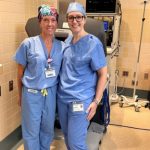
A surgical team at AHN Allegheny General Hospital recently completed the region’s first robotic-assisted kidney transplant, marking a significant advancement in transplant care in Southwestern Pennsylvania.
The procedure was performed in April by Dr. Jennifer Carpenter, a transplant surgeon and director of the living donor kidney transplant program at AHN, who was assisted by physician’s assistant Sarah Skeba.
James Polka, 52, of Kittanning, was the first patient at AHN to undergo the robot-assisted kidney transplant.
AHN has routinely performed robotic nephrectomies, or kidney removal, from living donors since 2018, but the surgery marks the first time the technology has been used to assist in the implantation of a donor kidney into a recipient.
Kidney disease occurs when the kidneys lose their ability to filter waste and excess fluid from the blood, often progressing to kidney failure if left untreated. Today, more than 90,000 people in the U.S. are waiting for a kidney transplant, making it the most in-demand organ.
In a traditional kidney transplant, surgeons make a larger abdominal incision to place the donor kidney. With robotic assistance (AHN utilized the daVinci Surgical System), surgeons operate through smaller incisions using high-precision instruments and enhanced 3D visualization, which can reduce wound complications and support faster recovery.
“For many of our patients, a kidney transplant isn’t just a procedure; it’s the culmination of years of waiting and is a true gift of life that transforms their future,” said Carpenter. “We are incredibly pleased to now offer this minimally invasive robotic-assisted surgical option for recipients. It not only represents a significant advancement in care but also stands to get our patients on the path to healing and wellness even more quickly.”
Polka received a kidney through the National Kidney Registry paired kidney exchange program, which connects incompatible donor-recipient pairs to increase transplant opportunities.
AHN has facilitated more than 160 kidney transplants through paired donation, and also played a key role in one of the longest kidney transplant chains ever completed, with two donor-recipient pairs contributing to the 35-transplant sequence in 2015.
AHN is one of only a small number of transplant centers nationwide that performs robotic kidney transplants for recipients.
Carpenter said the robotic approach may be especially beneficial for patients who are morbidly obese, including those with a body mass index of 40 or higher, as well as older patients or those with complex medical conditions who may face higher complication risks from a traditional open procedure.
In some cases, those factors can limit access to transplantation, making minimally invasive approaches an important tool in safely expanding eligibility.
“The size and location of the traditional incision can increase the risk of complications,” said Carpenter. “Using the robot can make the operation technically easier and may improve outcomes for these higher-risk groups.”