

Reaction mixed from regional lawmakers to budget
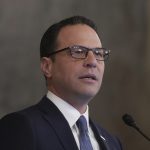
The all-Republican delegation of state lawmakers from the region had mixed reactions to the $50.8 billion state budget that was approved by the General Assembly Sunday and signed by Gov. Josh Shapiro.
The 2026-27 budget, which was completed 12 days after its mandated deadline, was described by some legislators as a compromise, where both Republicans and Democrats were able to walk away with something, while others characterized it as fiscally irresponsible, saying it sets the stage for future tax hikes.
“We all hoped this could be completed on time, but working a few extra days resulted in a better product,” said state Rep. Tim O’Neal, who represents Washington, Donora, South Strabane and other communities in Washington County.
O’Neal explained that the spending plan has no tax increase, and that some of the spending Shapiro had requested was whittled down, so the state’s Rainy Day Fund will not be tapped. O’Neal also pointed to cost-of-living adjustments for retired police officers, firefighters, teachers and state employees and $775 million in funding for rural road and bridge projects.
Rep. Josh Kail, who represents portions of both Beaver and Washington counties, including Burgettstown and Claysville, also pointed to funding for rural roads and bridges as a victory, as well as funding for education included in the budget.
“Pennsylvania families deserve a state budget that lives within its means,” Kail said. “While this budget is far from perfect, it is significantly more responsible than where the process began. … This matters because it reflects months of pushing back against excessive spending and insisting on greater fiscal restraint.”
Sen. Camera Bartolotta, whose district includes all of Washington and Greene counties and a portion of Beaver County, said the budget provides targeted funding to help ease Pennsylvania’s nursing shortage and $81 million in additional support for skilled nursing facilities. Bartolotta also said the budget strengthens efficiency and oversight within the Pennsylvania Department of Transportation (PennDOT).
“We said ‘no’ to new taxes, kept our emergency savings safe, put unused taxpayer money back to work, and invested in infrastructure, healthcare and economic growth,” Bartolotta said. “This budget helps Pennsylvania keep moving forward and keeps us ready for future challenges.”
Rep. Jason Ortitay, whose district includes communities in southern Allegheny County and northern Washington County, said the budget includes some of his priorities, such as literacy funding, more support for education, eating disorder awareness and a study of alternatives to the Keystone Exam.
“This budget shows that when both parties are willing to work together, we can deliver real results for Pennsylvania families, no matter which side of the aisle they stand on.”
Meanwhile, Rep. Bud Cook, whose district includes all of Greene County and a slice of southern Washington County, slammed the budget as being “structurally deficient” and that it relies on “accounting maneuvers to mask the commonwealth’s financial situation.”
“It’s a shame we needed to use taxpayer money to come in on a weekend to do the work of the people after House Democrats, who are in the majority, failed to get a reasonable budget to the Senate on time that both sides could agree on.”
Cook’s colleague, Rep. Ryan Warner, who represents Brownsville, Connellsville, Dunbar and other Fayette County communities, said “the General Assembly is passing a budget that spends too much and puts Pennsylvania taxpayers on the path toward a future tax hike.”
He added, “It’s time to stop growing government on the backs of taxpayers. If Harrisburg supposedly has this much money to spend, then it’s time to give some of it back to the hard-working people who earned it.”
Rep. Charity Grimm Krupa, whose district includes Uniontown, said the budget was an example of “voodoo budgeting,” and that “Pennsylvania families are expected to make difficult financial decisions every day. They have every right to expect the same discipline from their government.”
She added, “When Harrisburg claims there isn’t enough money, the first question should be whether we’re spending taxpayer dollars wisely.”
Shapiro characterized the budget as a bipartisan triumph, saying that despite a divided Legislature “we’ve proven time and again that Democrats and Republicans can come together to get stuff done for the good of the people of Pennsylvania …”
The budget process was completed a little less than two weeks after the July 1 deadline, but it was still delivered in a comparatively timely fashion compared to the 2025-26 state budget, which Shapiro finally signed last November. The longest Pennsylvania has gone without an approved state budget was the nine-month standoff between Democratic Gov. Tom Wolf and a Republican-controlled Legislature that was ultimately resolved in March 2016, when Wolf allowed the budget to become law without his signature.
Rep. Natalie Mihalek, whose district includes parts of northern Washington County and southern Allegheny County, said, “In previous years, partisan bickering ran amok while budget negotiations were unproductive and unnecessarily hostile, which puts undue burdens on school districts and care providers.”
She added, “By successfully coming to a budget agreement, we can now focus on the quality-of-life issues that make our communities affordable, safe places to live, work and play.”